
|
by Alex M. Vikoulov  “Homo sapiens does its best to forget the fact, but it is an animal. And it is doubly important to remember our origins at a time when we seek to turn ourselves into gods.” –Yuval Noah Harari Humans are arguably the most peculiar species that has ever existed. Characterized by exceptionally large brains capable of abstract thought, invention, and sophisticated communication through language, humans are also notable for their near hairlessness, weak jaws, and disproportionately large reproductive organs. We are highly social and face unique challenges in childbirth. How did such an unusual species come to be?
We now know that all existing lifeforms stem from a solitary progenitor known as LUCA, or the Last Universal Common Ancestor. This perspective is perhaps the most cohesive view of life imaginable. Every living entity is connected back to this singular, simple cellular origin—the most fundamental root of the elaborate Tree of Life. Reversing life’s timeline, this microscopic entity appears as the initial spark of biological evolution, setting the stage for a dramatic unfolding over 3.5 billion years that leads to us.
1 Comment
by Alex M. Vikoulov  "Chaos is what we've lost touch with. This is why it is given a bad name. It is feared by the dominant archetype of our world, which is Ego, which clenches because its existence is defined in terms of control." - Terence McKenna Listen to this article ↴ From the vantage point of digital philosophy, the world is governed by a ceaseless battle of opposites. What appears as chaos on one stratum manifests as harmony and order on another, more elevated, level. Delving into the microscopic realm, we witness cells and microbes devouring each other in what seems like a miniature war. Yet, paradoxically, this microscopic carnage is a prerequisite for the healthy functioning of our human organism. Similarly, in the grand tapestry of Nature, a "food pyramid" delineates the roles of predator and prey, consumer and consumed. While it may look like a relentless competition, it's an intrinsic part of the natural ecosystem. Each element exists in relation to another, contributing to a larger, divine order. In this framework, even the act of "eating" each other and our environment is not anarchy but rather a structured dance choreographed by the laws of Nature, emergent behavior, and rules of self-organization, perhaps, set in motion by God himself. by Alex Vikoulov  “Old Newtonian physics claimed that things have an objective reality separate from our perception of them. Quantum physics, and particularly Heisenberg's Uncertainty Principle, reveal that, as our perception of an object changes, the object itself literally changes.” –Marianne Williamson Listen to this article ↴ In the intricate landscape of consciousness studies, an interdisciplinary confluence of scientific inquiry, philosophical speculation, and elements of techno-mysticism emerges. This exploration aims to challenge conventional paradigms and proffer a multifaceted examination of the nature of the conscious mind. Among the humongous spectrum of available first-person experiences, the act of selecting a singular manifest phenomenon for awareness yields what I call a Conscious Instant (CI). A sequence of these perceptual frames constitutes what is generally known as the "stream of consciousness," which creates your continuous flow of time and your unitary sensation of reality. Video: What is Consciousness? Consciousness: Evolution of the Mind, Part I (cc)
by Alex Vikoulov | Foreword to GaeaGenesis: Conception and Birth of the Living Earth by Oberon Zell  "The Earth has entered a radically new era, understood by scientists as the Anthropocene: a time when humanity reckons with massive geologic and biospheric forces we, as anthropos, have set in motion. The agency of Nature and the reality of humanity as a collective geologic force is becoming understood differently, even within the Western paradigm. It is a new world our children will inherit, for if humanity is to survive, we must come into new realizations of our place within the planetary life-support systems. To lay a path for future generations through the evolutionary steps that humanity must now take to learn to live in balance with the planet, science must come to balance with Spirit." ―Oberon Zell, GaeaGenesis
In the early 1970s, celebrated philosopher and mystic Oberon Zell was the first to propose the radical idea that the biosphere of Earth was a single living superorganism. His initial article on the subject electrified the emerging modern movement of Earth-based spirituality, generating volumes of correspondence, lecture tours, and further articles in various journals and books. The excitement was the result of a simple yet profound idea. Imagine for a moment that Earth is alive. Not just teeming with living things, but a living, vital organism encompassing the whole of the planet. This is how Oberon Zell imagines it in GaeaGenesis, but it is more than imagination or mere metaphor. GaeaGenesis is the first work to fully integrate the mythological, spiritual, biological, and social history of what has become known as the Gaea Thesis. It builds upon this history by exploring the profound implications of the thesis, which is as significant to our understanding of the world and our place in it as the heliocentric theory of the solar system and Darwin’s theory of evolution once were. by Oberon Zell  "Evolution of consciousness is indeed a spiritual process as well as it is a never-ending process of rational discovery." ―Alex Vikoulov Following is the review of The Syntellect Hypothesis: Five Paradigms of the Mind's Evolution (2020) by Alex M. Vikoulov This is a brilliant and complex book with a vast scope, and consequently a challenge to review in a few paragraphs. It’s an entire graduate University course in 525 dense pages! I found myself taking copious notes and copying many paragraphs I may wish to quote in my own books on these topics. Indeed, I discovered herein quotations from my own writings of over 50 years ago! Universal Consciousness | A New Documentary Consciousness: Evolution of the Mind, Part IV12/24/2021 by Elizabeth Titovskaya 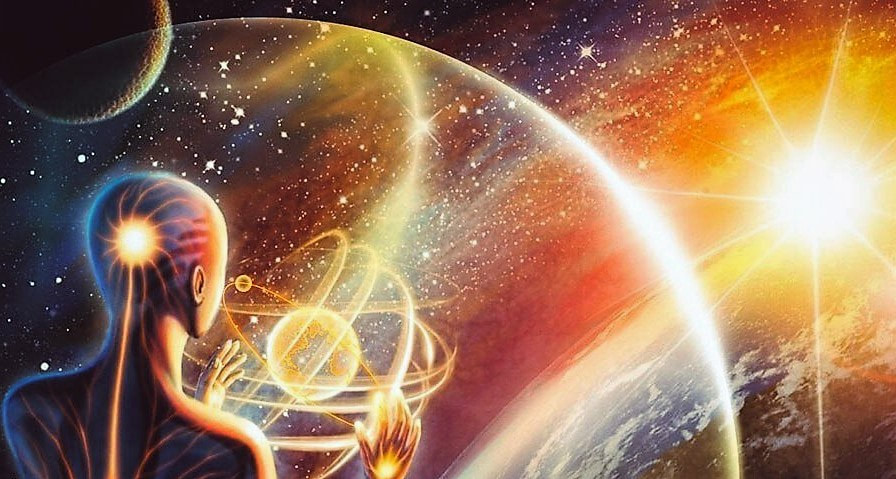 "Vedanta teaches that consciousness is singular, all happenings are played out in one universal consciousness and there is no multiplicity of selves.” ―Erwin Schrödinger
Universal consciousness is the sole ontological primitive and we are fragments of it. There's only one universal substance – consciousness and only one medium –information. Thus, consciousness and information are the two sides of the same ontological coin. Consciousness is all that is: A phenomenal "local" mind is cybernetically emergent from an underlying functional organization while holistic "non-local" consciousness is transcendentally immanent. In other words, Universal Consciousness is absolute, your mind is relative. Reality is created by interacting conscious agents all the way down and all the way up. Our experiential reality is projected onto the multidimensional matrix-like “screen” of perception for our evolving minds. By preference, you can see yourself as a low-dimensional avatar of the greater cosmic self, or a God incarnate if you prefer, which can be encapsulated by a simple phrase: “Your life is a personal story of Godhead.” by Oberon Zell 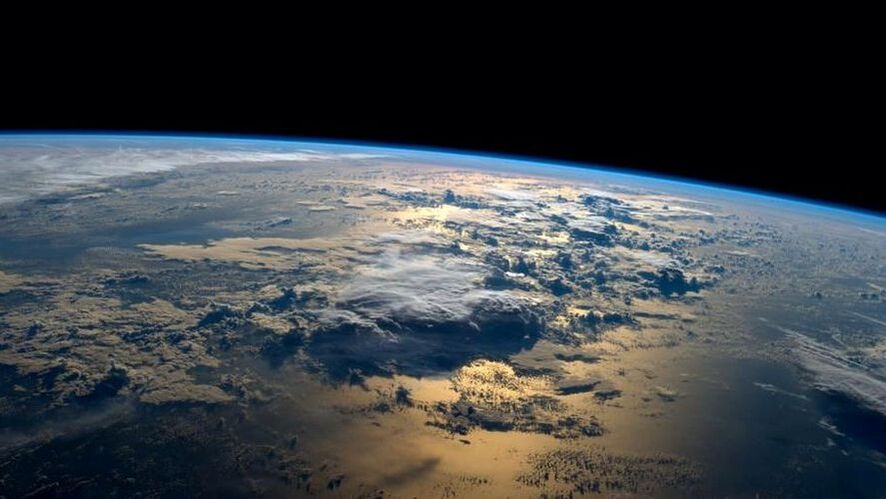 "Spiritually inclined rationalists may view this ongoing evolutionary process as one of 'Theogenesis'… On a long billions-of-years evolutionary journey from the first primordial prokaryote to a Solaris-like planetary mind, we’re merely years away from this cardinal metamorphosis." --Alex Vikoulov, Theology of Digital Physics (2019)
THE EARTH MOTHER IN HUMAN CULTURES “Of Earth I sing, eldest of all and Mother of the Gods...” So begins the Homeric Hymn to Gaea, the Earth Mother. Gaea is the name given by the ancient Greeks to the primordial planetary goddess worshipped by humanity since the dawn of the Stone Age. The original form of Her name, Ge (Γε), is the root of the names of the Earth sciences, geology, geophysics and geography, as well as geode, geometry, geomancy, etc. Even small children intuitively know Mother Earth or Mother Nature. She is the oldest and most universal religious archetype in all of human experience. Images and figurines of Her date back to the Cro-Magnon Aurignacian peoples of over 30,000 years ago, and are found across the Eurasian continent from Spain to Siberia. In Hesiod's Theogony, Gaea was created by Light and by Love from the primal cosmic Chaos. Her first offspring was Uranus, the Heavens. Pierced by the arrows of Eros, Gaea gave birth to all the plants, animals, Titans, Gods and Goddesses, and of course the human race. So Gaea is the Mother of us all, according to Greek mythology. |

Categories
All
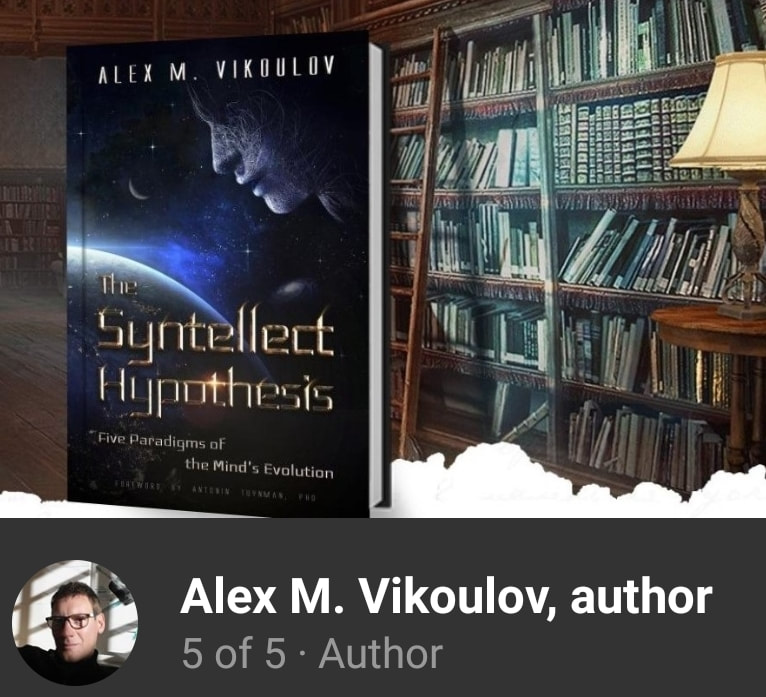
Recent Publications The Cybernetic Theory of Mind by Alex M. Vikoulov (2022): eBook Series The Syntellect Hypothesis: Five Paradigms of the Mind's Evolution by Alex M. Vikoulov (2020): eBook Paperback Hardcover Audiobook The Omega Singularity: Universal Mind & The Fractal Multiverse by Alex M. Vikoulov (2022): eBook THEOGENESIS: Transdimensional Propagation & Universal Expansion by Alex M. Vikoulov (2021): eBook The Cybernetic Singularity: The Syntellect Emergence by Alex M. Vikoulov (2021): eBook TECHNOCULTURE: The Rise of Man by Alex M. Vikoulov (2020) eBook NOOGENESIS: Computational Biology by Alex M. Vikoulov (2020): eBook The Ouroboros Code: Reality's Digital Alchemy Self-Simulation Bridging Science and Spirituality by Antonin Tuynman (2019) eBook Paperback The Science and Philosophy of Information by Alex M. Vikoulov (2019): eBook Series Theology of Digital Physics: Phenomenal Consciousness, The Cosmic Self & The Pantheistic Interpretation of Our Holographic Reality by Alex M. Vikoulov (2019) eBook The Intelligence Supernova: Essays on Cybernetic Transhumanism, The Simulation Singularity & The Syntellect Emergence by Alex M. Vikoulov (2019) eBook The Physics of Time: D-Theory of Time & Temporal Mechanics by Alex M. Vikoulov (2019): eBook The Origins of Us: Evolutionary Emergence and The Omega Point Cosmology by Alex M. Vikoulov (2019): eBook More Than An Algorithm: Exploring the gap between natural evolution and digitally computed artificial intelligence by Antonin Tuynman (2019): eBook Our Facebook Pages

A quote on the go"When I woke up one morning I got poetically epiphanized: To us, our dreams at night feel “oh so real” when inside them but they are what they are - dreams against the backdrop of daily reality. Our daily reality is like nightly dreams against the backdrop of the larger reality. This is something we all know deep down to be true... The question then becomes how to "lucidify" this dream of reality?"— Alex M. Vikoulov Public Forums 
Our Custom GPTs
Alex Vikoulov AGI (Premium*)

#ecstadelic collection (keyword-based design on products from apparel to home decor)
The Book Club collection (Your favorite book front cover on products from apparel to accessories)
Be Part of Our Network! *Subscribe to Premium Access Make a Donation Syndicate Content Write a Paid Review Submit Your Article Submit Your Press Release Submit Your e-News Contact Us
|