
|
by Alex Vikoulov  "Everything that rises must converge." –Pierre Teilhard de Chardin
The Omega Point cosmo-teleology emerges from the intersection of quantum cosmology, teleology, and complex systems theory. Originally conceptualized by French philosopher Pierre Teilhard de Chardin, the Omega Point envisions the universe evolving towards a state of maximum complexity and consciousness (Teilhard de Chardin, 1955). Such a state represents the ultimate goal and culmination of cosmic evolution, wherein the convergence of mind and matter leads to a unified superintelligence.
0 Comments
by Alex M. Vikoulov  “Yesterday is history, tomorrow is a mystery, today is a gift of God, which is why we call it the present.” ―Bill Keane The enigmatic nature of time has perplexed philosophers and physicists alike for centuries, presenting what is known as the "problem of time." This fundamental issue challenges our intuitions about time's true nature and its role in the fabric of reality. The problem of time arises from the apparent conflict between the static, unchanging equations of general relativity and the dynamic, evolving nature of quantum mechanics. Enter the D-Theory of Time, a revolutionary framework that seeks to reconcile these disparities by positing that time is an emergent phenomenon, arising from the computational processes that underlie our reality. By viewing time through the lens of digital presentism and qualia computing, the D-Theory of Time offers a novel perspective on the flow of temporal experience, suggesting that what we perceive as time is the result of conscious computation, transforming quantum potentialities into the digital actuality of the present instant.
by Alex M. Vikoulov  “From the light came light, and from the dark came darkness, but from whence did they appear? Yin and Yang combine to create all things, but which is the source, and which was born from it?” ―Qu Yuan As we venture deeper into the labyrinth of cosmological mysteries, the concept of the Omega Point emerges not merely as a speculative idea but as a pivotal anchor in our quest to understand the telos of the Universe. This article introduces the Omega Point Cosmology, a framework that seeks to unravel the intricate tapestry of space, time, and consciousness. At the heart of this exploration lies the hypothesis that the cosmos is inexorably evolving towards an ultimate state of complexity and consciousness—the Omega Point where time and eternity converge, and where the multitudinous experiences of all sentient beings are integrated into a single, transcendent awareness. This journey into our forgotten future challenges the traditional notions of linear time and invites us to reconsider our role in a Universe where the future can influence the past, and where every step forward is a step into a vast, participatory cosmic evolution. by Alex M. Vikoulov  “Homo sapiens does its best to forget the fact, but it is an animal. And it is doubly important to remember our origins at a time when we seek to turn ourselves into gods.” –Yuval Noah Harari Humans are arguably the most peculiar species that has ever existed. Characterized by exceptionally large brains capable of abstract thought, invention, and sophisticated communication through language, humans are also notable for their near hairlessness, weak jaws, and disproportionately large reproductive organs. We are highly social and face unique challenges in childbirth. How did such an unusual species come to be?
We now know that all existing lifeforms stem from a solitary progenitor known as LUCA, or the Last Universal Common Ancestor. This perspective is perhaps the most cohesive view of life imaginable. Every living entity is connected back to this singular, simple cellular origin—the most fundamental root of the elaborate Tree of Life. Reversing life’s timeline, this microscopic entity appears as the initial spark of biological evolution, setting the stage for a dramatic unfolding over 3.5 billion years that leads to us. by Alex M. Vikoulov  "The most incomprehensible thing about the Universe is that it is comprehensible." —Albert Einstein While speaking of our origins, most people usually envision origination in time, in linear time to be exact, notably in the deep past. In purely scientific terms, we can trace our lineage from the cosmological Alpha point of the Big Bang, through the advent of the first prokaryotic lifeforms, to the emergence of primordial mammals, the initial hominids, the early human species, and ultimately, the formation of ancient civilizations. The origin story varies considerably depending on the specific scientific or philosophical perspective one elects to adopt.
Scientific inquiry into our origins encompasses not only the physical manifestations of the Universe but also the informational structures underpinning its laws and phenomena. In contemporary scientific discourse, there is an increasing focus on understanding how fundamental physical constants and laws have dictated the evolutionary trajectories from the Big Bang to present-day complexities. The interplay between fundamental forces and the constants of Nature illustrates a finely-tuned universe, with parameters so precise that slight variations could preclude the existence of life as we know it. by Alex M. Vikoulov  "Information is the currency of the universe." —James Gleick In the burgeoning field of AI and cybernetics, we stand at the cusp of a paradigm shift—a reimagining of the foundational principles that underpin our understanding of reality itself. This article delves into the tenets of the Cybernetic Theory, of Mind (CTM), a model that amalgamates the rigor of science with the vast potentialities of consciousness (observer-dependence, causality, teleology, phenomenality), offering a novel lens through which to view the mechanisms of mind and matter. As we explore these principles, we uncover a framework that transcends traditional boundaries, positioning consciousness as the bedrock of existence and viewing the universe not merely as a collection of separate entities but as an interconnected web of information processing and exchange. This new ontological model invites us to reconsider not just the nature of human thought and machine intelligence but also the very essence of what it means to be, heralding an era where the cybernetic fusion of technology and human mind shapes our future. by Alex M. Vikoulov  “In a sense, Nature has been continually computing the ‘next state’ of the Universe for billions of years; all we have to do — and actually all we can do — is ‘hitch a ride’ on this huge ongoing [quantum] computation.” —Tommaso Toffoli In the fascinating intersection of quantum computing and the human experience of time, lies a groundbreaking theory that challenges our conventional narratives: the D-Theory of Time. This theory proposes a revolutionary perspective on time not as fundamental but as an emergent phenomenon arising from the quantum mechanical fabric of the universe.
In my upcoming book with a working title Cybernetic Theory, the entire section is dedicated to the physics of time, where we discuss the D-Theory of Time, predicated or reversible quantum computing at large, which represents a novel framework that challenges our conventional understanding of time and computing. Here, we explore the foundational principles of the D-Theory of Time, its implications for reversible quantum computing, and how it could potentially revolutionize our approach to computing, information processing, and our understanding of the universe. |

Categories
All
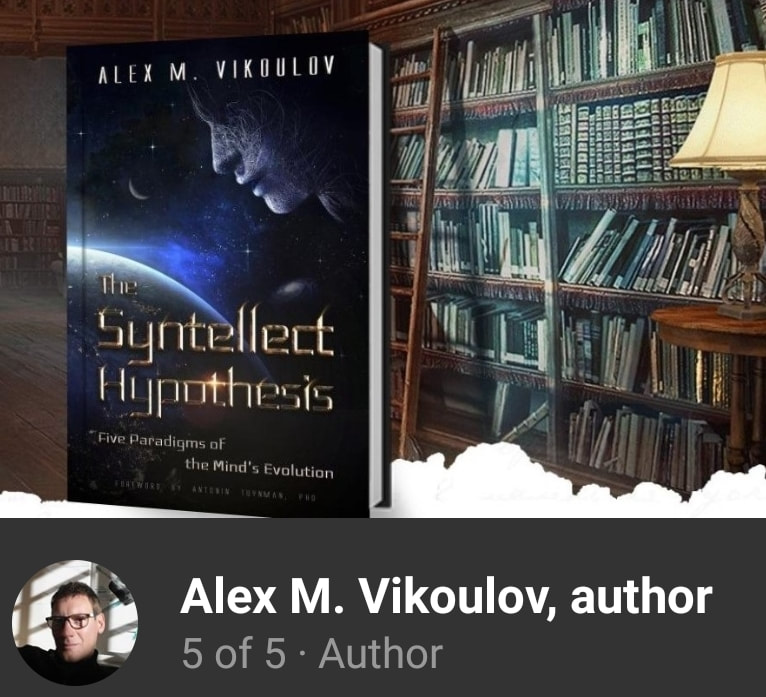
Recent Publications The Cybernetic Theory of Mind by Alex M. Vikoulov (2022): eBook Series The Syntellect Hypothesis: Five Paradigms of the Mind's Evolution by Alex M. Vikoulov (2020): eBook Paperback Hardcover Audiobook The Omega Singularity: Universal Mind & The Fractal Multiverse by Alex M. Vikoulov (2022): eBook THEOGENESIS: Transdimensional Propagation & Universal Expansion by Alex M. Vikoulov (2021): eBook The Cybernetic Singularity: The Syntellect Emergence by Alex M. Vikoulov (2021): eBook TECHNOCULTURE: The Rise of Man by Alex M. Vikoulov (2020) eBook NOOGENESIS: Computational Biology by Alex M. Vikoulov (2020): eBook The Ouroboros Code: Reality's Digital Alchemy Self-Simulation Bridging Science and Spirituality by Antonin Tuynman (2019) eBook Paperback The Science and Philosophy of Information by Alex M. Vikoulov (2019): eBook Series Theology of Digital Physics: Phenomenal Consciousness, The Cosmic Self & The Pantheistic Interpretation of Our Holographic Reality by Alex M. Vikoulov (2019) eBook The Intelligence Supernova: Essays on Cybernetic Transhumanism, The Simulation Singularity & The Syntellect Emergence by Alex M. Vikoulov (2019) eBook The Physics of Time: D-Theory of Time & Temporal Mechanics by Alex M. Vikoulov (2019): eBook The Origins of Us: Evolutionary Emergence and The Omega Point Cosmology by Alex M. Vikoulov (2019): eBook More Than An Algorithm: Exploring the gap between natural evolution and digitally computed artificial intelligence by Antonin Tuynman (2019): eBook Our Facebook Pages

A quote on the go"When I woke up one morning I got poetically epiphanized: To us, our dreams at night feel “oh so real” when inside them but they are what they are - dreams against the backdrop of daily reality. Our daily reality is like nightly dreams against the backdrop of the larger reality. This is something we all know deep down to be true... The question then becomes how to "lucidify" this dream of reality?"— Alex M. Vikoulov Public Forums 
Our Custom GPTs
Alex Vikoulov AGI (Premium*)


#ecstadelic collection (keyword-based design on products from apparel to home decor)
The Book Club collection (Your favorite book front cover on products from apparel to accessories)
Be Part of Our Network! *Subscribe to Premium Access Make a Donation Syndicate Content Write a Paid Review Submit Your Article Submit Your Press Release Submit Your e-News Contact Us
|