
|
by Antonin Tuynman, PhD | Foreword to The Syntellect Hypothesis: Five Paradigms of the Mind's Evolution by Alex M. Vikoulov  "At a deep level all things in our Universe are ineffably interdependent and interconnected, as we are part of the Matryoshka-like mathematical object of emergent levels of complexity where consciousness pervades all levels." -Alex M. Vikoulov, The Syntellect Hypothesis If you picked up this book, it is not unlikely that you may have heard of the early 20th century philosophical movement of Cosmism. This movement, which originated in Russia, was striving for conquering the planets and stars, for radical life extension, immortality and resurrection of our loved ones by the means of technology. Perhaps one of its most important pioneers was Konstantin Tsiolkovsky, whose aspirations did not only venture into the realm of the Macro, but also explored the Micro. He spoke of the atomic world as being animated and can thus be considered a kind of cosmist-panpsychist.
0 Comments
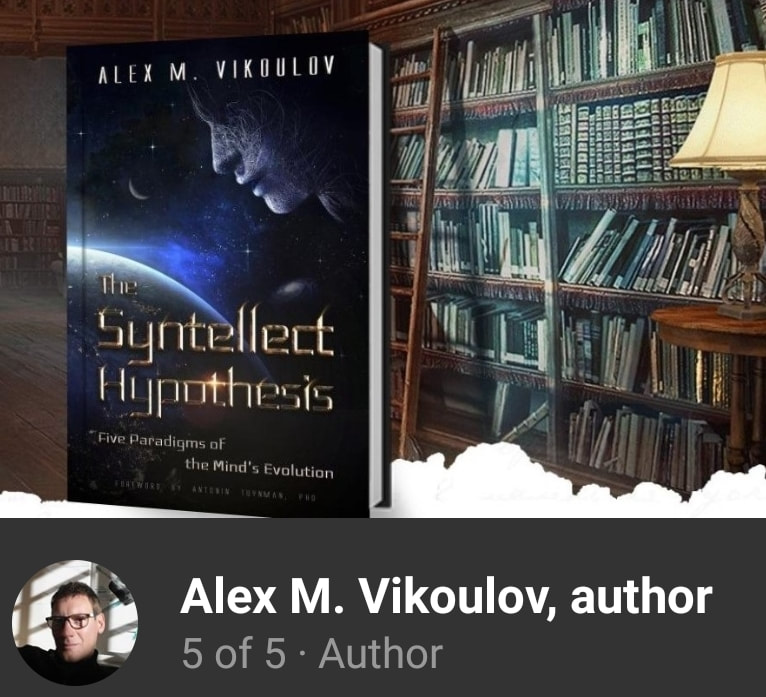
by Alex M. Vikoulov  "A powerful work! As a transhumanist, I especially loved one of the main ideas of the book that the Syntellect Emergence, merging of us into one Global Mind, constitutes the quintessence of the coming Technological Singularity. The novel conceptual visions of mind-uploading and achieving digital immortality are equally fascinating. The Chrysalis Conjecture as a solution to the Fermi Paradox is mind-bending. I would highly recommend The Syntellect Hypothesis to anyone with transhumanist aspirations and exponential thinking!" -Zoltan Istvan, futurist, author, founder of the U.S. Transhumanist Party Terms such as 'Artificial Intelligence' or 'Neurotechnology' were new some time not so long ago. We can't evolve faster than our language does. We think in concepts and evolution itself is a linguistic, code-theoretic process. Do yourself a humongous favor, look over these 33 transhumanist neologisms. Here’s a fairly comprehensive glossary of thirty three newly-introduced concepts and terms from "The Syntellect Hypothesis: Five Paradigms of the Mind's Evolution" by Russian-American futurist, evolutionary cyberneticist and philosopher of mind Alex M. Vikoulov. In parts written as an academic paper, in parts as a belletristic masterpiece, this recent book is an exceptionally easy read for an intellectual reader -- a philosophical treatise that is fine-tuned with apt neologisms readily explained by given definitions and contextually:   Book by Alex M. Vikoulov, Overview*
"To be conscious that we are perceiving is to be conscious about our own existence." -Aristotle, 384-382 B.C. “To have a glimpse of what consciousness is would be the scientific achievement before which all others would pale.” -William James "Regard the physical world as made of information, with energy and matter as incidentals." -John Wheeler Everything, including energy, matter, space, time, and even consciousness, is INFORMATION, or Code if you will. Many scientists now come to consensus that information may be fundamental, since information patterns persist through dimensions and, it seems, is an evolving phenomenon. Even in our "physical" world, we arguably exist as information patterns encoded in our genome, connectome, and our extended "virtual" self. All atoms in our bodies are gradually replaced as a result of metabolic activities within a 7-year period. The purpose of this essay is to give you an overview of my new 2019 book "The Syntellect Hypothesis: Five Paradigms of the Mind's Evolution" where we will explore the conscious mind's journey through times and paradigms with the focus on what's most important to us conscious beings -- OUR SUBJECTIVE EXPERIENCE. by Alex Vikoulov  "Capitalism does not permit an even flow of economic resources. With this system, a small privileged few are rich beyond conscience, and almost all others are doomed to be poor at some level. That's the way the system works. And since we know that the system will not change the rules, we are going to have to change the system." -Martin Luther King, Jr. On May 6, 2010, the Dow Jones index opened lower than the previous day, falling slowly over the next few hours in response to the debt crisis in Greece. But at 2.42pm, the index started to fall rapidly. In less than five minutes, more than 600 points were wiped off the market. At its lowest point, the index was nearly 1,000 points below the previous day’s average, a difference of almost 10% of its total value, and the biggest single-day fall in the market’s history. By 3.07pm, in just 25 minutes, it recovered almost all of those 600 points, in the largest and fastest swing ever, what professional market participants would call a “black swan” event. I was trading on that roller coaster 'Flash Crash' historical day and saw it with my eyes -- the rapid decline and just as rapid rebound of the markets and my own portfolio. I remember watching commentator Jim Cramer on CNBC hysterically screaming from the bottom of his lungs: "This is unreal! This is not right! The system obviously broke down! The machines broke down!" What a wild ride that was! I'll tell you! by Alex Vikoulov  "This deep power in which we exist, and whose beatitude is all accessible to us, is not only self-sufficing and perfect in every hour, but the act of seeing and the thing seen, the seer and the spectacle, the subject and the object, are one.” -Ralph Waldo Emerson, The Over-Soul (1841) I'm always leery when some neuroscientist comes along and says: “We are the brain. There’s nothing besides it. If something is wrong, it’s physical.” No, you are not a "brain in a vat," and if we are to deconstruct human intelligence, it would make sense to apply the so-called top-down “holistic” analysis — when we work from the general to the specific — the big picture to the smaller details, from the superset to the subset. So, in this type of analysis we should not start with the brain. Instead, if viewed collectively, human intelligence is a networking phenomenon based on technology and culture that we call civilization; and individually, it's an operating system of the person's mind. by Alex Vikoulov  "Basic income is not a utopia, it's a practical business plan for the next step of the human journey." -Jeremy Rifkin Unconditional Basic Income (also called basic income guarantee or social dividend) is a system of social security in which all citizens or residents of a country regularly receive an unconditional sum of money from a government regardless of any other income. Pilot programs have been introduced in a number of European countries and aimed at replacing outdated bureaucratic welfare systems altogether. by Alex Vikoulov  "Transhumanism literally means 'beyond human.' It's using science and technology to radically change and improve the human species and experience." -Zoltan Istvan
The contemporary transhumanist movement aims to transform the human condition by developing and making widely available advanced technologies to greatly enhance human intellectual, physical, and psychological potential. Transhumanists believe that human beings may eventually be able to transform themselves into different beings with superior God-like capacities -- posthumans. The three transhumanist "Super Pillars" are: Superlongevity, Superintelligence, and Super Wellbeing. According to Kurzweil’s “Law of Accelerating Returns,” exponential technologies will bring about ever more rapid changes in human evolutionary development. We will move from where we are today, increasingly dependent on external computers that help us conduct business and access information, to the next level where computers gradually become an integral part of us. Most transhumanists would like to become superintelligent themselves. This is obviously a long-term goal, but it might be achievable either through mind-uploading and subsequent enhancement or through the gradual augmentation of our biological brains, by means of future nootropics (cognitive enhancement drugs), cognitive techniques, IT tools (e.g. wearable computers, smart agents, information filtering systems, visualization software, etc.), neural interfaces, or brain implants (more on that further). When transhumanists seek to extend human lifespan, they want to live longer, healthier, happier, more productive years, be able to do, learn, and experience more; have more fun and spend more time with loved ones. But the ultimate superlongevity goal of transhumanists is indefinitely long lifespan for all: to digitize our minds, upload our minds onto the Global Brain Cloud, and achieve the so-called digital immortality. A transhumanist philosopher David Pearce promotes the idea that there exists a strong ethical imperative for humans to work towards the abolition of suffering in all sentient life. In "The Hedonistic Imperative" he outlines how genetic engineering, nanotechnology, pharmacology, and neurosurgery could potentially converge to eliminate all forms of unpleasant experience among human and non-human animals, replacing suffering with gradients of well-being, a project he refers to as “Paradise Engineering.” Pearce writes: "...there is nothing to stop intelligent agents from identifying the molecular signature of experience below hedonic zero and eliminating it altogether — even in insects… I tentatively predict that the world’s last unpleasant experience in our forward light-cone will be a precisely datable event — perhaps some micro-pain in an obscure marine invertebrate a few centuries hence."* |

Categories
All
Recent Publications The Cybernetic Theory of Mind by Alex M. Vikoulov (2022): eBook Series The Syntellect Hypothesis: Five Paradigms of the Mind's Evolution by Alex M. Vikoulov (2020): eBook Paperback Hardcover Audiobook The Omega Singularity: Universal Mind & The Fractal Multiverse by Alex M. Vikoulov (2022): eBook THEOGENESIS: Transdimensional Propagation & Universal Expansion by Alex M. Vikoulov (2021): eBook The Cybernetic Singularity: The Syntellect Emergence by Alex M. Vikoulov (2021): eBook TECHNOCULTURE: The Rise of Man by Alex M. Vikoulov (2020) eBook NOOGENESIS: Computational Biology by Alex M. Vikoulov (2020): eBook The Ouroboros Code: Reality's Digital Alchemy Self-Simulation Bridging Science and Spirituality by Antonin Tuynman (2019) eBook Paperback The Science and Philosophy of Information by Alex M. Vikoulov (2019): eBook Series Theology of Digital Physics: Phenomenal Consciousness, The Cosmic Self & The Pantheistic Interpretation of Our Holographic Reality by Alex M. Vikoulov (2019) eBook The Intelligence Supernova: Essays on Cybernetic Transhumanism, The Simulation Singularity & The Syntellect Emergence by Alex M. Vikoulov (2019) eBook The Physics of Time: D-Theory of Time & Temporal Mechanics by Alex M. Vikoulov (2019): eBook The Origins of Us: Evolutionary Emergence and The Omega Point Cosmology by Alex M. Vikoulov (2019): eBook More Than An Algorithm: Exploring the gap between natural evolution and digitally computed artificial intelligence by Antonin Tuynman (2019): eBook Our Facebook Pages

A quote on the go"When I woke up one morning I got poetically epiphanized: To us, our dreams at night feel “oh so real” when inside them but they are what they are - dreams against the backdrop of daily reality. Our daily reality is like nightly dreams against the backdrop of the larger reality. This is something we all know deep down to be true... The question then becomes how to "lucidify" this dream of reality?"— Alex M. Vikoulov Public Forums 
Our Custom GPTs
Alex Vikoulov AGI (Premium*)


#ecstadelic collection (keyword-based design on products from apparel to home decor)
The Book Club collection (Your favorite book front cover on products from apparel to accessories)
Be Part of Our Network! *Subscribe to Premium Access Make a Donation Syndicate Content Write a Paid Review Submit Your Article Submit Your Press Release Submit Your e-News Contact Us
|